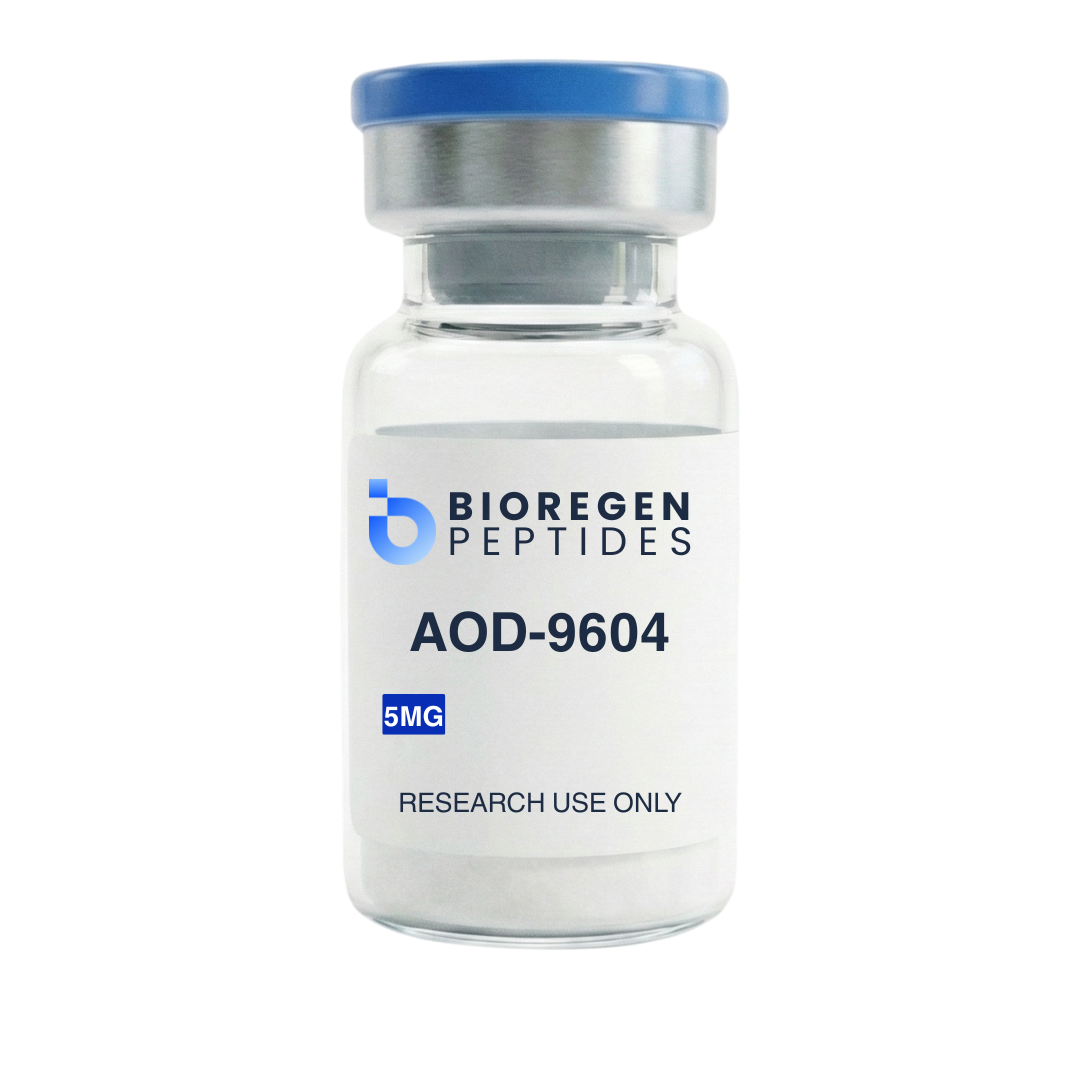
AOD-9604
AOD-9604 (Advanced Obesity Drug)
The Precision Lipolytic Fragment
AOD-9604 is a synthetic analog of the C-terminal fragment of Human Growth Hormone (hGH 177-191). It is engineered to isolate the fat-burning properties of growth hormone without triggering the growth-promoting (IGF-1) or insulin-disrupting side effects associated with full-molecule hGH.
-
Mechanism: Stimulates lipolysis (fat breakdown) and inhibits lipogenesis (fat storage) by targeting beta-3 adrenergic receptors in adipose tissue.
-
Key Advantage: Does not impact blood sugar or cellular proliferation, making it a highly selective metabolic research tool.
-
Research Focus: Visceral adiposity reduction, metabolic efficiency, and potential chondrocyte (cartilage) regeneration.
-
Purity: >99% (Third-party HPLC/MS verified).
-
Format: Lyophilized powder for laboratory research use.
Strictly for laboratory and research purposes only.
$1.00
AOD-9604 Research-Grade Lipolytic Peptide Fragment
Product Overview
AOD-9604 (Advanced Obesity Drug) is a synthetic peptide fragment representing the C-terminal end of the human Growth Hormone (hGH) molecule, specifically amino acids 177–191, with an added tyrosine at the N-terminal to stabilize the structure.
In scientific literature, AOD-9604 is highly distinguished because it isolates the lipolytic (fat-burning) properties of growth hormone from its growth-promoting (somatotropic) effects. Unlike full-molecule hGH, AOD-9604 does not bind to the growth hormone receptor (GHR), meaning it does not stimulate IGF-1 production, interfere with glucose metabolism, or cause cellular proliferation. Its primary mechanism is the stimulation of beta-3 adrenergic receptors and the inhibition of acetyl-CoA carboxylase in adipose tissue. This triggers a potent “fat-releasing” response—accelerating the breakdown of fats (lipolysis) and preventing the transformation of non-fatty foods into body fat (lipogenesis)—making it a premier compound for investigating metabolic efficiency and obesity without the side effects of traditional GH therapy.
Primary Research Applications
Under doctor-reviewed scientific literature, AOD-9604 is frequently utilized in in vitro and animal model studies to observe:
-
Targeted Lipolysis: Investigating the breakdown of white adipose tissue, particularly in mesenteric (visceral) regions, without affecting lean muscle mass.
-
Metabolic Non-Interference: Observing the peptide’s ability to reduce adiposity without altering blood glucose levels or insulin sensitivity.
-
Cartilage & Bone Repair: Measuring the potential regenerative effects on chondrocytes (cartilage cells) in models of osteoarthritis and joint injury.
-
Lipogenesis Inhibition: Tracking the reduction in the formation of new triglycerides within fat cells.
The BioRegen Standard
When you source your AOD-9604 from BioRegen Peptides, you are backed by our five core pillars of quality and service:
-
Uncompromising Purity: Every batch is independently third-party tested to guarantee >99% purity and molecular integrity, ensuring your metabolic research data is precise and reproducible.
-
Doctor-Reviewed Accuracy: All product specifications and research handling guidelines are medically reviewed for absolute scientific accuracy.
-
Unbeatable Value: Premium, verified research compounds at industry-disrupting prices.
-
Fast, US-Based Shipping: Stocked physically in the USA to bypass customs delays and arrive at your lab in days.
-
Dedicated Support: Have a question about the C-terminal fragment mechanism? Email our US-based team at support@bioregenpeptides.com for a rapid response.
Product Specifications
-
Nomenclature: AOD-9604, Tyr-hGH Frag 177-191
-
Amino Acid Sequence: Tyr-Leu-Arg-Ile-Val-Gln-Cys-Arg-Ser-Val-Glu-Gly-Ser-Cys-Gly-Phe
-
CAS Number: 221231-10-3
-
Molecular Formula: $C_{78}H_{123}N_{23}O_{23}S_{2}$
-
Purity: >99% (Verified via HPLC/MS)
-
Format: Lyophilized Powder
Regulatory Notice: This product is sold strictly for laboratory and research purposes only. It is not intended for human consumption, diagnostic, therapeutic, or prophylactic use. Please refer to our doctor-reviewed handling guidelines for proper research protocols.